
 Gift Giving
 Schedule Appointment


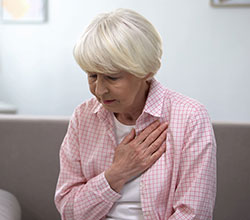
Wolff-Parkinson-White (WPW) Syndrome was first named in 1930 after three physicians, (Wolff, Parkinson and White) who discovered a distinct electrocardiograph (ECG) pattern in healthy young people with short bursts of a rapid heart rate (tachycardia).
Wolff-Parkinson-White (WPW) Syndrome is characterized as an abnormal electrical condition in the heart that may be associated with supraventricular tachycardia (fast heart rate originating above the ventricles). Wolff-Parkinson-White (WPW) Syndrome can cause 100 or more heart beats per minute. The fast heart rate, or tachycardia, can come and go suddenly. A normal heart rate is 60-100 beats per minute.
Wolff-Parkinson-White (WPW) Syndrome develops when an extra piece of heart muscle causes another electrical conduction pathway (called an accessory pathway) between the upper and lower chambers within your heart. The electrical impulses of your heart then travel through both the extra pathway (short cut) as well as the normal pathway. This forces the impulses to travel around the heart very quickly, in a circular pattern, which causes the heart to beat unusually fast. Sometimes the fast heartbeat caused by Wolff-Parkinson-White (WPW) Syndrome can go back to normal on its own. Other times, treatment will be needed to manage this type of condition.
Wolff-Parkinson-White (WPW) Syndrome is a type of congenital heart abnormality that most people are born with. The condition is not common, it is rare, occurring in approximately 1 to 3 people in a general population of 1,000. Some cases of Wolff-Parkinson-White (WPW) Syndrome are inherited. Parents who have an accessory pathway may pass this same abnormality to their children. In most cases, however, the condition occurs randomly in infants at birth.
People of all ages can experience Wolff-Parkinson-White (WPW) Syndrome, although it is usually diagnosed in children, adolescents, and young adults. It should be noted that about 40% of patients experience no symptoms at all.
Symptoms of Wolff-Parkinson-White (WPW) Syndrome can last a few seconds to a few hours and can include:
Urinating more than usual, or heavy sweating
A percentage of people with Wolff-Parkinson-White (WPW) Syndrome can experience a more serious type of irregular heartbeat called A-fib (atrial fibrillation). In these cases, symptoms such as chest pain, chest tightness, dizziness, and difficulty breathing may be present.
A diagnosis of Wolff-Parkinson-White (WPW) Syndrome can be made after your physician conducts a thorough clinical evaluation, a detailed patient history, and a variety of specialized tests. These may include:
Electrophysiologic Studies (EPS): EPS tests the electrical activity of your heart.
Treatment for Wolff-Parkinson-White (WPW) Syndrome depends on how severe the symptoms are and how often the symptoms occur. Some treatments can stop the episodes of fast heart beats (tachycardia) while other treatments can prevent episodes from happening in the future. Treatments can include:
 Find a Physician
 About Us
 Careers
 Pay Your Bill
 Help Paying Your Bill
 Price Transparency